Skip to content

About

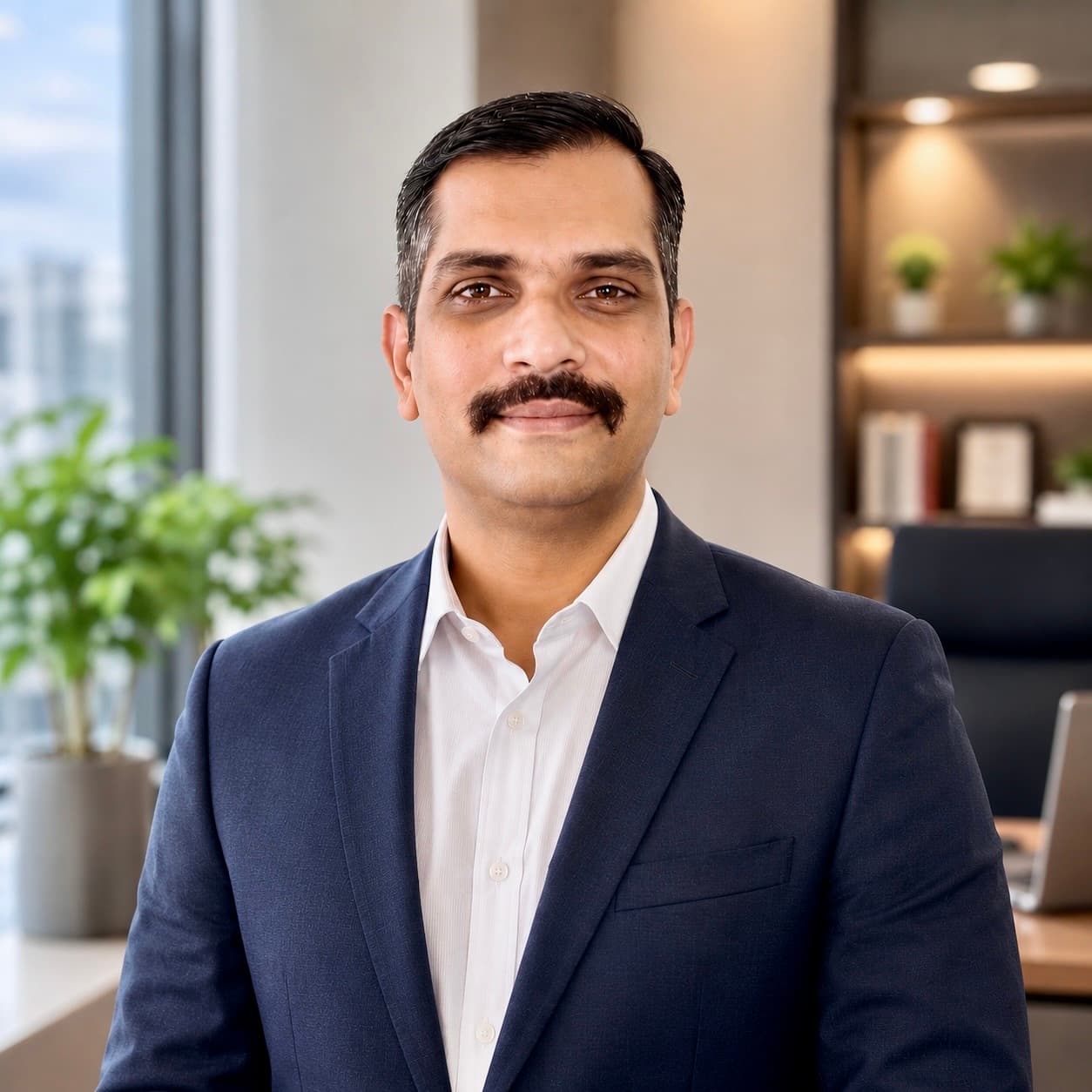
Ashish Kumar Agnihotri

Fractional COO & Business Excellence Advisor

I have spent nineteen years making operations work — and most of that time, the work was invisible. A good operating model is felt as an absence: of firefighting, of surprises, of the founder being the bottleneck.

Ashish Agnihotri

I did not set out to work in operations. Almost no one does — it is the discipline you arrive at when you care more about whether the thing actually works than about who gets the credit. My route ran through engineering, then through one of the largest communications groups in the world — and now to fractional engagements with companies directly.

At Publicis I worked at a scale that does not forgive a weak operating model. When you are responsible for quality across 500-plus clients and more than USD 750 million in annual media spend, you cannot hold it together with effort. The maths defeats you. You have to build systems — quality frameworks, governance, measurement — that hold without you watching every piece. That is where the methods I use now were forged: the Makegoods QA framework that protected more than twenty million dollars in billings, quality lifted from ninety-five to ninety-nine percent across two thousand campaigns and 450 clients, and makegoods on a major APAC account driven from USD 200,000 to zero.

None of those were heroic individual efforts. Every one was a change to how the work was designed — which is the only kind of improvement that survives once you walk away.

I take on fractional engagements because the companies that need this most often cannot justify a full-time chief operating officer, and cannot afford to keep improvising either. They are between stages: too big for the founder to be the operating system, too early for a full executive bench. That gap is exactly where an experienced operating partner, present a few days a week, changes the trajectory.
How I think about operations

A few beliefs the work rests on.

Measure before you form an opinion

The engineering habit that still governs how I work: when something is not performing, the first move is to measure it, not to theorise about it. Most operating arguments are really disagreements about facts nobody has gathered. Put numbers on the real process and the right decision usually becomes obvious — and defensible to the people who have to live with it.

Quality is a property of the system

When work goes wrong, the cheap and useless response is to find someone to blame. The useful response is to find the flaw in the system that let it happen. People respond to how work is designed; change the design and behaviour follows. Every durable improvement I have made was a change to the system, not an exhortation to try harder.

The best engagement is one you can end

I am not trying to become indispensable. The goal is to install an operating model your own team can run, and then to hand it over cleanly. An advisor who makes themselves permanent has, in a quiet way, failed at the actual job — which is to leave the company more capable than it was, not more dependent on one more person.

Fewer numbers, trusted more

A leadership team does not need a hundred metrics; it needs the handful that map to how the business actually creates value, defined once and trusted. The discipline is in what you leave out. A small scorecard the team genuinely steers by is worth more than a dashboard nobody reads and everyone quietly argues with.

Decisions belong close to the work

A business slows when every decision has to climb to the top and back down. Part of installing an operating model is pushing decisions down to where the information actually is — giving people clear ownership and the authority to act within it. The founder stops being a bottleneck not by working faster, but by no longer needing to be in the room for decisions other people are better placed to make.

Define the standard before you measure

You cannot judge quality honestly until you have agreed what good means — in terms specific to the work, the client and the risk. A standard borrowed from elsewhere measures the wrong things; a vague one measures nothing at all. Defining the standard first is unglamorous, and it is where most of the value sits, because everything downstream — the score, the audit, the remediation — depends on it being right.

01The arc

From measuring things to measuring organisations.

2001–05 · GBPUA&T

An engineer first

A B.Tech in Civil Engineering gave me the habit that still defines how I work: when something is not working, you measure it before you have an opinion about it. Operations is engineering applied to how an organisation does its work.

2005–07 · XLRI Jamshedpur

The management lens

A postgraduate qualification (PGDPM&IR) from XLRI added the discipline of seeing operations as a system of incentives, governance and decision rights — not just process. Engineering taught me to measure; XLRI taught me where to point the measurement.

2007–12 · Raymond, Q&Q Research

Where the operating craft got real

Before the work was about scale, it was about evidence — building HR scorecards and BI across 23 business units at Raymond, then reporting and audits at scale: 4,500+ retail stores across 19 telecom circles for Vodafone, and benchmarking the Election Commission of India used to shape its 2012 voter-education programme.

Until recently · Publicis Groupe

Business Excellence at scale

As Senior Director, Business Excellence, I led quality and delivery across global digital operations — 500+ clients, teams of 2,000+, and more than USD 750 million in annual media spend. It is where the methods came together: the Makegoods QA framework that protected USD 20M+, and quality lifted from 95% to 99% across 2,000+ campaigns and 450 clients.

Now

Fractional operating partner

I bring that experience to a small number of companies at a time as a fractional COO and Business Excellence advisor — installing the operating systems that let growth hold its shape, then handing them back.

Areas of expertise

Business ExcellenceQuality ManagementLean Six SigmaOperations ManagementFractional COOProcess TransformationProcess AutomationOperations GovernanceBusiness IntelligenceData GovernanceProgram ManagementDigital TransformationBusiness Strategy

Education

  • XLRI JamshedpurPGDPM&IR, 2005–07
  • GBPUA&T, PantnagarB.Tech, Civil Engineering, 2001–05

Certifications

  • Lean Six Sigma — Green Belt
  • Business Strategy — Harvard Business School Online
  • Fundamentals of Project Management — Google (Coursera)
  • Agile Process Management — Google Certified

What working together looks like

I work as an operating partner, not an adviser who watches from outside. That means sitting inside the leadership team, taking the decisions I am given the authority to take, and staying accountable for whether the operating model actually holds under load. The relationship only works on candour — I need the real picture, including what is not working, and you need my honest read even when it is uncomfortable.

Almost every engagement opens with a short, fixed-fee diagnostic: a few weeks inside the business, reading the numbers and tracing how work moves from sale to delivery to cash, ending in a written assessment and a clear recommendation. If we continue, the work moves to a monthly retainer of one to three days a week, scaled to what the business needs and lightening as ownership transfers to your team.

Throughout, the aim is transfer rather than dependency. The cadence, the ownership map, the scorecard and the playbooks are documented as we go, so that when the engagement ends — and it is designed to end — your team, or an incoming full-time COO, can run the operating model without me. The measure of a good engagement is how cleanly I can step away from it.

Questions

Common questions.

Operations-heavy companies that have outgrown improvisation — most often between roughly 50 and 500 people — and larger enterprises and capability centres where quality and governance at scale are the whole game. The common thread is an operating model under strain, not a particular industry, though my experience runs deepest in delivery operations, agencies and media, BPO and shared services, and scaling founder-led businesses.

I work independently as a fractional operating partner, taking on a small number of companies at a time rather than a single full-time seat. That is deliberate: the model lets companies that are not ready for — or cannot find — a full-time COO still get senior operating discipline, sized to what they need now.

A firm typically studies a problem and hands over a recommendation for someone else to implement. I embed in the leadership team, own the implementation, and stay accountable for whether the operating model holds. You get one senior operator inside the business, not a team of analysts producing a document — and the deliverable is a running system, not a deck.

Nineteen years in operations — an engineering foundation, a postgraduate qualification from XLRI Jamshedpur, and a tenure as Senior Director, Business Excellence at Publicis Groupe carrying quality and delivery across 500+ clients and more than USD 750 million in annual media spend — now brought to companies directly as a fractional COO.

Engagements start with a fixed-fee diagnostic and then move to a monthly retainer scaled to cadence and scope — never billed by the hour. The structure rewards outcomes rather than time, and the diagnostic keeps the first step low-commitment so you can judge the fit before committing further.

Yes. I am based in Gurgaon and work across India, and with global teams — having carried quality and delivery across global clients and time zones, a distributed engagement is familiar ground. The work is remote-first, with on-site time where it earns its place.

The simplest first step is a short call about where your operating model is under strain. From there, a fixed-fee diagnostic is usually the right entry point. You can reach me through the contact page, by email, or on LinkedIn.

Almost all of this work happens inside a business under confidentiality, and I treat client information accordingly — it is why the case studies describe outcomes and scale rather than naming most clients. A non-disclosure agreement is a normal part of starting an engagement, and discretion is part of the job rather than an add-on.

Yes — the role is built to work through your existing leadership, not to displace it. I make ownership clearer and give the team a rhythm to run by, and I am comfortable working alongside other advisors, an interim, or a PMO where they are already in place. The aim is to leave your leaders stronger and clearer, never to add another silo.

Deliberately few. This is hands-on operating work, not a portfolio of light advisory retainers, so the number of concurrent engagements is kept small enough that each gets real attention and genuine presence. It is part of why the work holds — an operating partner who is spread thin can comment on outcomes but cannot own them.

Work with me

If your operating model is starting to strain, that is the right time to talk — not after it breaks.